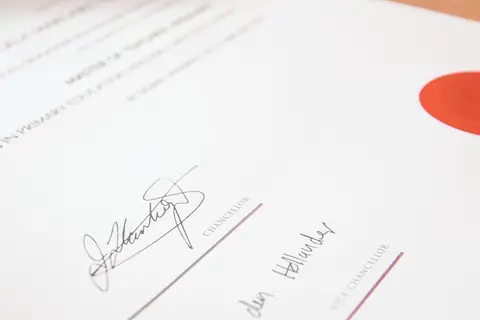
Why notarization comes first
The Hague Convention covers “notarial acts” and “official certificates placed on private documents”. A letter you wrote carries no public signature; once a notary signs and seals a notarial certificate on it, the notary’s signature becomes the public act the state can authenticate. The apostille will name the notary in field 2 and “Notary Public” in field 3.
What a complete notarial certificate contains
State apostille offices check the notarial certificate line by line. Common elements:
- Venue — “State of _, County of _”.
- Date of the notarial act.
- Certificate wording — either an acknowledgment (“acknowledged before me…”) for documents the signer is adopting as their own, or a jurat (“sworn to and subscribed before me…”) for sworn statements. Some states reject documents with no wording at all, just a signature and stamp.
- Notary’s signature exactly as commissioned.
- Notary’s printed name, commission number and expiration date where the state requires them.
- Seal or stamp — required in most states; a few (for example, some New England states) accept a signature without an embossed seal.
Any element missing is the most frequent reason a notarized document is returned. The notarial certificate must also be for the document it is attached to; loose acknowledgments stapled to unrelated pages are refused.
The notary must be commissioned in the apostilling state
A state apostilles only the signatures of its own notaries. A document notarized in Georgia cannot be apostilled in Florida, even if the signer lives in Florida. If a document must be apostilled by a specific state (for example because it will be filed along with other documents from that state), it must be notarized by a notary of that state.
Copy certification
Many people need an apostille on a copy of a passport, driver’s license, diploma or naturalization certificate. Options depend on state law:
- Notary copy certification — the notary compares the copy to the original and certifies it. Permitted in Florida, California (only for certain documents), Texas, Arizona and others; prohibited or restricted in states such as New York and Georgia for identity documents.
- Copy certification by document custodian — the owner signs an affidavit swearing the copy is true, and the notary notarizes the affidavit. Accepted in most states as a workaround where direct copy certification is not allowed.
- Certified copies from the issuer — for vital records, court records and corporate documents, the issuer’s certified copy is always the stronger option.
Federal law prohibits copying certain documents (for example, USCIS warns that reproducing a Certificate of Naturalization is restricted), and some countries will not accept a notarized copy of an ID in any case. Check the document pages and the country pages.
Remote online notarization (RON)
About 45 states now authorize remote online notarization, in which the signer appears before the notary by video and signs electronically. For apostille purposes:
- The resulting document is usually a PDF with the notary’s electronic signature and seal. Some states apostille electronically notarized documents only as e-apostilles; others require a paper printout accompanied by a notary’s paper certificate, and a few refuse electronic notarizations for apostille entirely. The state pages note where RON documents are accepted.
- The notary’s commission state, not the signer’s location, determines the apostilling state. Signers abroad commonly use a Florida, Texas or Virginia online notary and then apostille in that state.
County pre-certification
In a minority of states, a notarized document must first go to the county clerk of the county where the notary is commissioned (or where the act took place) for a certificate of the notary’s authority, and only then to the state. New York applies this to most notarized documents; Tennessee, Alabama, Kentucky, Maryland (for some counties), Pennsylvania (older rules) and others apply it in specific situations. Each state page states whether county certification is required.
Translations and notaries
A notary can notarize a translator’s affidavit of accuracy, which turns a private translation into an apostillable document. The notary does not vouch for the translation’s accuracy. Whether the destination accepts a U.S. notarized translation at all is covered in the translation guide.
When the document is signed in Florida
Florida permits notary copy certification and remote online notarization, and the Florida Department of State apostilles both paper and electronic notarizations. People who need a Florida document notarized and apostilled in one visit typically use a local office — for example a Palm Beach County apostille office that works by appointment, an apostille and notary office in Fort Lauderdale or a Hillsborough County apostille office that works by appointment — or a statewide Florida apostille service that files in Tallahassee for mailed and online requests.
Frequently asked questions
Can any notary notarize a document for an apostille?
Any active notary commissioned in the state that will issue the apostille, provided the notarial certificate is complete. Notaries cannot issue apostilles themselves.
My document was notarized years ago. Can it still be apostilled?
Usually yes, as long as the notary’s commission was valid on the date of notarization and the state still has the notary’s signature on file. Some states cannot verify notaries whose commissions expired long ago.
Can a notary notarize a document written in another language?
In most states yes, if the notary can communicate with the signer and the notarial certificate itself is in English. A few states require the notary to understand the document.
Does a notary stamp on a photocopy make it an original?
No. It makes the notarial certificate an authenticable public act. The receiving country decides whether a notarized copy is acceptable for its purpose — many registries insist on the original certified record.