What to check on the certificate
Fields 6 (date), 7 (issuing authority), 8 (number) and 10 (signature) are the verification keys. Also confirm:
- The certificate is physically attached to the document (staples, grommets, ribbon or adhesive seal) and the seal partially overlaps both where that is the issuing office’s practice.
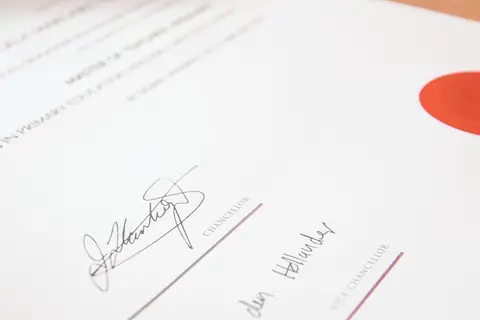
- The signer named in field 2 and the capacity in field 3 match the signature actually on the document.
- The headings follow the ten-field format with the French title.
Online registers
A growing number of U.S. states maintain e-registers where anyone can enter the apostille number and date and see a confirmation (and, for e-apostilles, the certificate itself). The states that issue e-apostilles (Connecticut, Kentucky, Utah) run registers, and others have added verification pages; the Hague Conference’s e-APP page lists participating authorities. The state pages link to each state’s apostille office, where a verification link appears when one exists.
The U.S. Department of State does not currently offer public online verification for federal apostilles; receiving parties contact the Office of Authentications.
Contacting the competent authority
When there is no online register, the receiving party emails or calls the issuing office with the apostille number and date. Offices answer such inquiries routinely — the Convention requires them to (Article 7). Document holders can also request confirmation if they suspect a problem.
Red flags for forgery
- An apostille issued by an authority that does not exist (for example, “U.S. Apostille Office” or a notary’s own “apostille”).
- Missing or inconsistent fields, wrong French subtitle, spelling errors in the headings.
- A certificate naming a signer who did not sign the document.
- Seal printed with a color copier rather than embossed or printed on security paper, where the office uses those.
- A “notarized apostille” or “apostille stamp” offered by an individual — only competent authorities issue apostilles.
Several state offices and the Department of State have published warnings about fraudulent apostille websites impersonating government agencies. The official sites are always on .gov domains, which this portal links to on every state and federal page.
Verifying foreign apostilles in the U.S.
The same logic applies in reverse: an apostille issued by Spain, Mexico or Brazil is verified against that country’s register, often online (Spain, Colombia, Argentina, Chile and Brazil all have public registers). U.S. offices do not verify foreign apostilles.
Frequently asked questions
Can a notary verify an apostille?
No. Only the issuing competent authority can confirm its own apostille. A notary can only compare documents.
Is a stamped 'apostille' from a service genuine?
Only if the certificate was issued by a competent authority. A service’s own stamp is not an apostille. Check field 7 for the issuing authority.
My apostille number isn't found online. Is it fake?
Not necessarily. Some registers lag by days, and some states do not publish an online register. Contact the issuing office.